
Best Fence Types for Charleston SC Weather - Wind, Rain & Salt Air
If you’ve lived in Charleston for any length of time, you already know this: our weather doesn’t play nice with fences.
Between strong coastal winds, heavy rain, constant humidity, and salt air drifting inland, not every fence is built to last here. We’ve seen fences that looked great on day one start failing far sooner than expected — not because they were cheap, but because they weren’t right for Charleston.
So when people ask us about the best fence types for Charleston, the answer isn’t about trends or looks alone. It’s about how materials respond to wind, moisture, and salt over time.
This guide breaks down which fence types actually perform best in Charleston SC weather — and which ones tend to struggle.
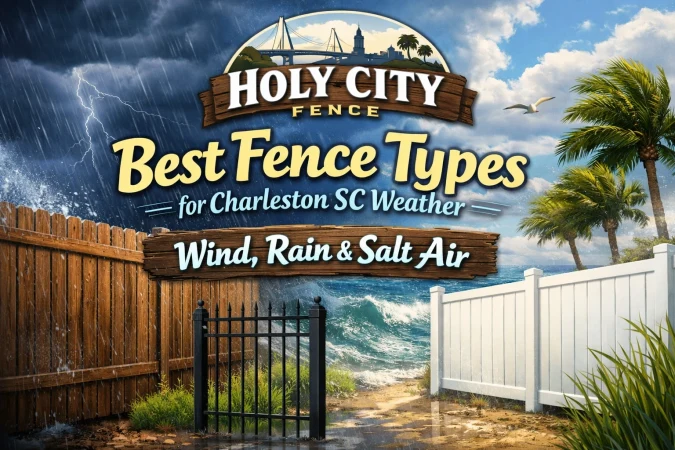
Table of Contents
Charleston’s climate creates a unique combination of stress factors that fences in other regions simply don’t face.
Here’s what fences deal with here:
- Strong wind gusts, especially during storm season
- Heavy rainfall that keeps soil saturated
- High humidity that slows drying and accelerates rot
- Salt air that speeds up corrosion on metal
- Sandy soil that shifts more easily than dense clay
A fence that works perfectly inland or up north may fail quickly here if it isn’t designed for these conditions.
That’s why choosing the best fence types in Charleston isn’t optional — it’s essential.
What Makes a Fence “Charleston-Proof”?
From years of installing and repairing fences locally, we’ve learned that the best-performing fences in Charleston share a few traits:
- They don’t absorb moisture easily
- They resist rust and corrosion
- They allow wind to pass through or flex safely
- They’re installed with deeper posts and proper drainage
- They’re designed with storms in mind, not just curb appeal
With that in mind, let’s walk through the fence types that hold up best — and why.
Aluminum fencing consistently ranks at the top when it comes to Charleston weather.
Aluminum Fencing — One of the Best Fence Types for Charleston
Why? Because aluminum simply doesn’t rust.
Even with constant humidity and salt air, aluminum holds its shape and strength year after year. It also allows wind to pass through, which reduces pressure during storms.
Why aluminum works well in Charleston:
- Rust-proof (ideal for salt air)
- Lightweight but strong
- Minimal maintenance
- Handles wind better than solid panels
We often recommend aluminum for:
- Properties near marshes or waterways
- Areas exposed to frequent wind
- Pool enclosures
- Properties that want durability without constant upkeep
It’s one of the safest long-term choices for coastal conditions.
Vinyl Fencing — Strong Against Moisture & Rain
Vinyl fencing performs very well in Charleston’s wet, humid climate.
Unlike wood, vinyl doesn’t rot, warp, or absorb water. It stays clean and structurally stable even during long rainy periods.
That’s why vinyl is often considered one of the best fence types for Charleston SC weather, especially for properties that want privacy without maintenance.
Why vinyl works well here:
- Moisture-resistant
- No rot or insect damage
- Holds up well in humidity
- Easy to clean after storms
That said, quality matters. Lower-grade vinyl can crack under impact or stress, especially during storms with flying debris.
Installed correctly, vinyl fences hold up extremely well against Charleston rain and humidity.
Pressure-Treated Wood Fences — Can Work – With Conditions
Wood fences are common in Charleston — and yes, they can work here.
But only if they’re built properly and maintained.
Wood struggles more than other materials in:
- Constant humidity
- Standing moisture
- Poor drainage
However, pressure-treated wood designed for ground contact can still perform well if installed with deeper posts, proper spacing, and routine sealing.
Wood fences perform best when:
- Posts are set deep and reinforced
- Drainage is addressed
- Boards are sealed regularly
- Designs allow some airflow
Many storm-related failures we see aren’t because wood is “bad,” but because shortcuts were taken years earlier.
Wood can still be one of the best fence types for Charleston — just not a low-maintenance one. In addition, to decide between Wood VS Vinyl fence, you can read our blog also.
Chain Link Fencing — Practical, Wind-Friendly Option
Chain link fencing often gets overlooked, but it performs surprisingly well in Charleston weather.
Because it’s open, the wind passes through easily. There’s very little surface area for gusts to push against, which makes it storm-resistant by nature.
Why chain link works in storms:
- Minimal wind resistance
- Durable galvanized coatings available
- Cost-effective for large areas
The biggest risk with chain links in Charleston is corrosion if the coating wears down. Vinyl-coated or properly galvanized chain link performs best.
For properties focused on function and durability, chain link is a solid option.
Privacy Fences — Strong but Vulnerable to Wind
Privacy fences are popular, but they face the most stress during storms.
Solid panels act like sails. When strong gusts hit, pressure builds quickly. If posts or fasteners aren’t strong enough, failure happens fast.
That doesn’t mean privacy fences should be avoided — it means they must be built differently in Charleston.
Privacy fences perform best when:
- Posts are set deeper than standard
- Corners are reinforced
- Fasteners are upgraded
- Panels are properly spaced
Without those upgrades, privacy fences are often the first to fail during storms.
Fence Types That Struggle Most in Charleston Weather
Not all fences are well-suited for coastal environments.
Fence types that often struggle here include:
- Untreated wood fences
- Low-quality steel without proper coatings
- Shallow-set posts in sandy soil
- Decorative fences designed purely for looks
These fences may look good initially but tend to require frequent repairs over time.
Wind, Rain & Salt Air: How Installation Matters
Even the best fence types in Charleston can fail if installation doesn’t account for local conditions.
Key installation factors include:
- Proper post depth
- Concrete footings
- Drainage planning
- Wind exposure direction
Many fence problems show up years later, long after the original fence installation is forgotten.
If you’re curious about what typically goes wrong over time, our guide on Common Fence Problems in Charleston SC explains how weather and soil play a role in long-term fence failure.
Choosing the Right Fence for Your Property
Instead of asking “What’s the best fence overall?” the better question is:
What’s the best fence for this backyard or property in Charleston?
Things to consider:
- How exposed is the area to wind?
- Does water collect near fence lines?
- How much maintenance are you comfortable with?
- Is salt air a concern where you’re located?
The right answer varies — but Charleston weather should always be part of the decision.
Final Thoughts: The Best Fence Types for Charleston Are Built for Reality
Charleston fences don’t fail because of one bad storm.
They fail because small weather stresses add up over time.
The best fence types for Charleston SC weather are the ones designed to handle:
- Wind without resisting it
- Moisture without absorbing it
- Salt air without corroding
When material choice and installation work together, fences last longer and require fewer repairs.
Also, check out our residencial and commercial fencing page to choose the best fence.
FAQs
WHAT IS THE BEST FENCE TYPE FOR CHARLESTON WEATHER OVERALL?
Aluminum and vinyl consistently perform best due to resistance to rust and moisture.
IS WOOD FENCING A BAD CHOICE IN CHARLESTON?
Not necessarily, but it requires proper installation and regular maintenance.
DOES SALT AIR REALLY DAMAGE FENCES INLAND?
Yes. Salt air travels farther inland than most people realize.
WHICH FENCES HANDLE HURRICANES BEST?
Open designs like aluminum or chain link handle wind better than solid panels.
ARE PRIVACY FENCES A BAD IDEA IN CHARLESTON?
No, but they must be reinforced properly to handle wind pressure.
DOES VINYL FENCING CRACK IN STORMS?
High-quality vinyl holds up well; low-grade vinyl is more vulnerable.
HOW IMPORTANT IS POST DEPTH IN CHARLESTON SOIL?
Extremely important. Shallow posts are a major cause of fence failure.
WHICH FENCE TYPE NEEDS THE LEAST MAINTENANCE HERE?
Aluminum requires the least ongoing maintenance.
CAN THE WRONG FENCE TYPE INCREASE REPAIR COSTS LATER?
Absolutely. Poor material choices lead to frequent storm repairs.
SHOULD FENCE CHOICE CONSIDER DRAINAGE AND SOIL?
Yes. Charleston’s soil and drainage patterns matter as much as weather.