
Fence Repair vs Replacement in Charleston SC - How to Decide?
At some point, every property owner in Charleston runs into this question — usually after a storm, a few rough summers, or one too many “temporary fixes”:
Should we repair the fence… or is it time to replace it?
- Repair when damage is limited and posts are solid
- Replace when structural issues exist or repairs keep repeating
When it comes to fence repair vs replacement in Charleston, the answer isn’t always obvious. A fence can look bad and still be structurally sound — or look fine and be one strong wind away from failure. Charleston’s humidity, sandy soil, salt air, and storm cycles make this decision more important here than in many other places.
This guide walks through how to decide the right move without guesswork, pressure, or generic advice.
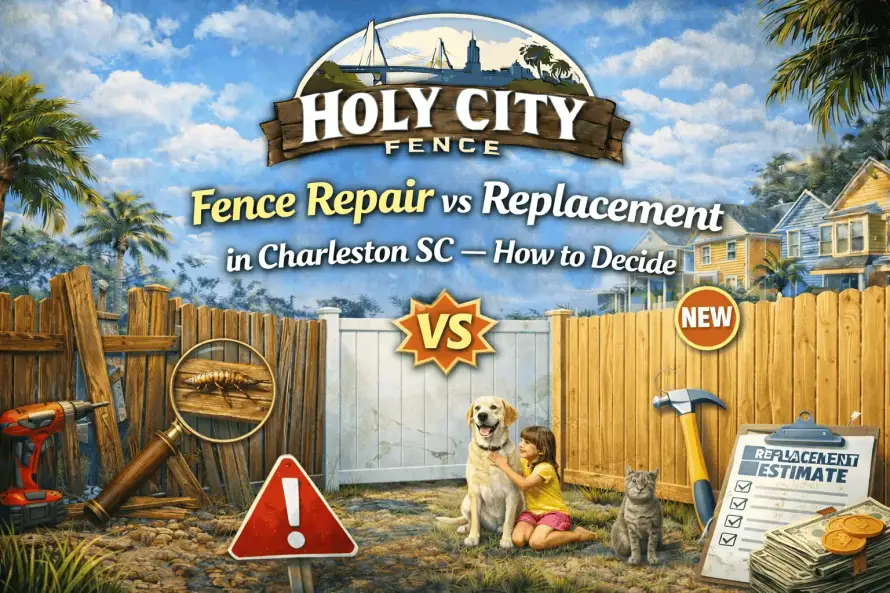
Table of Contents
Charleston fences don’t fail the same way fences do inland.
Here, problems usually come from:
- Soil staying wet for long periods
- Posts loosening below ground before damage is visible
- Salt air accelerating corrosion on metal parts
- Repeated wind stress during storm season
That means a fence can appear “repairable” but still be structurally compromised underneath.
Understanding what’s cosmetic — and what’s structural — is the key to making the right call.
When Fence Repair Makes Sense
Fence repair is often the right option when damage is limited and isolated.
Repair usually makes sense if:
- Less than 25–30% of the fence is damaged
- Posts are still solid and upright
- Panels are cracked, broken, or missing — but posts are stable
- Gates are sagging due to hardware, not post failure
- Damage was caused by a single event (storm debris, fallen branch)
In these cases, repairing specific sections can extend the fence’s life without the cost of a full replacement.
For Fence Cost Estimate, Use our Fence Cost Calculator Tool online.
Signs Your Fence Is a Good Candidate for Repair
We typically recommend repair when:
- Posts don’t move when pushed
- The fence hasn’t shifted or leaned noticeably
- Damage hasn’t repeated after every storm
- Wood rot hasn’t reached below ground level
- Metal corrosion is surface-level, not structural
A well-built fence with localized damage can often be repaired and perform reliably for years.
When Fence Replacement Is the Smarter Move
Replacement becomes the better option when problems are widespread or structural.
Replacement is usually the right choice if:
- Posts are leaning, rotting, or pulling out of the ground
- More than 30–40% of the fence is damaged
- Repairs have been done repeatedly over time
- The fence fails after most major storm
- Materials are reaching the end of their lifespan
In Charleston, repeated storm-related damage is often a sign that the fence wasn’t built for local conditions — not that it just needs another patch.
The Biggest Red Flag: Post Failure
Posts are the deciding factor more than panels.
If posts are:
- Loose
- Rotted below grade
- Rusted at the base
- Shifting after rain
…then replacing panels won’t solve the problem. The fence may look repaired, but the next storm will expose the same weakness again.
This is one of the most common reasons people end up paying twice.
Cost Comparison: Repair vs Replacement
Repair usually costs less upfront, but replacement can cost less over time.
Repair costs tend to be lower when:
- Damage is limited
- Posts are solid
- Access is easy
Replacement costs make sense when:
- Repairs keep adding up
- Structural issues are present
- A different material would perform better in Charleston’s climate
If you’re constantly fixing the same sections, replacement often becomes the more economical choice within a few years.
How Storm Season Should Influence Your Decision
Storm season is the stress test.
Ask yourself:
- Has this fence failed before during storms?
- Does it lean more after heavy rain?
- Are repairs holding up year to year?
If storm damage keeps returning, the issue is likely structural — and replacement with better design and deeper posts is usually the safer choice.
Material Matters in the Decision
Different fence materials age differently in Charleston.
- Wood fences may be repairable early, but widespread rot often means replacement
- Vinyl fences can be repaired panel-by-panel if posts remain solid
- Aluminum fences usually only need replacement if posts or welds fail
- Chain link fences are often repairable unless posts are shifting
The older the fence, the more likely replacement will outperform repeated repairs.
Code, Permits, and Replacement Decisions
Another factor many people overlook: rules and compliance.
Replacing a fence often triggers:
- Updated height or setback requirements
- Permit reviews
- HOA approval
Repairs typically don’t — unless the repair changes height, location, or design.
If your existing fence doesn’t meet current rules, replacement may require adjustments that repairs don’t.
The “Do It Right” Factor
We see this scenario often:
A fence is repaired.
It looks fine.
Six months later, another section fails.
At some point, it’s no longer about fixing what’s broken — it’s about addressing why it keeps breaking.
When replacement is done correctly, it resets the clock and removes recurring stress, maintenance, and surprise costs.
Check our commercial fence installation page for business and residential fence installation page for homes.
Final Thoughts: Repair or Replace?
So when it comes to fence repair vs replacement in Charleston, here’s the simplest way to think about it:
- Repair when damage is limited and posts are solid
- Replace when structural issues exist or repairs keep repeating
The right choice protects your property, your budget, and your peace of mind — especially going into storm season.
FAQs — Fence Repair vs Replacement in Charleston
WHAT IS THE BEST FENCE FOR KIDS AND KIDS IN CHARLESTON?
Check the posts first. Solid posts usually mean repair is possible.
IS IT CHEAPER TO REPAIR A FENCE THAN REPLACE IT?
Upfront, yes. Long-term, repeated repairs can cost more.
HOW MUCH DAMAGE IS TOO MUCH TO REPAIR?
If more than 30–40% of the fence is damaged, replacement is often smarter.
DO STORMS USUALLY CAUSE REPAIRABLE DAMAGE OR REPLACEMENT-LEVEL DAMAGE?
Single-event damage is often repairable. Repeated storm failures usually aren’t.
CAN A LEANING FENCE BE REPAIRED?
Sometimes — but leaning often signals post failure.
DOES FENCE AGE MATTER IN THE DECISION?
Yes. Older fences near the end of their lifespan are better replaced.
CAN VINYL FENCES BE REPAIRED EASILY?
Panels can be replaced if posts are stable.
DOES REPLACEMENT REQUIRE PERMITS?
Often yes, especially if height or location changes.
CAN REPLACING A FENCE REDUCE FUTURE STORM DAMAGE?
Yes — when built with deeper posts and better drainage.
WHAT’S THE MOST COMMON MISTAKE PROPERTY OWNERS MAKE?
Repairing panels without fixing failing posts.